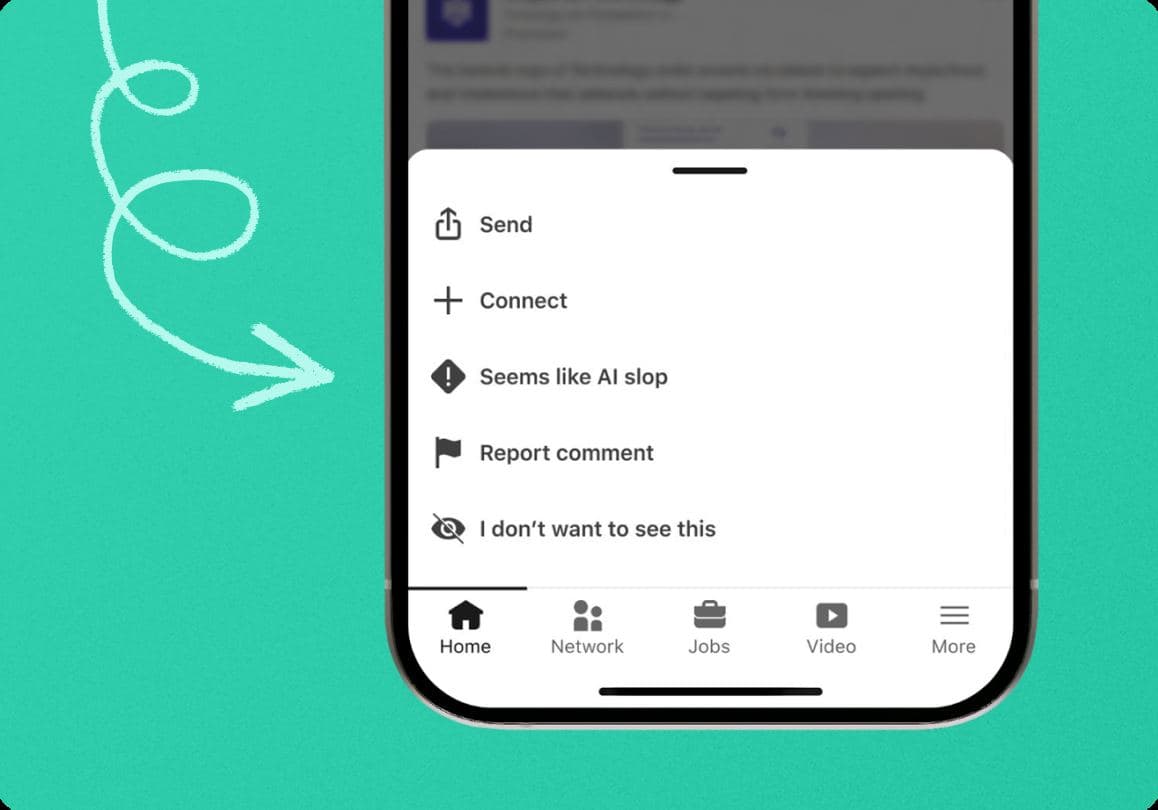
LinkedIn’s Hari Srinivasan has announced the introduction of one of its most significant content moderation features to date. Users can now report posts and comments that “seem like AI slop”, giving the platform another signal it can use when deciding which content deserves wider distribution.
The feature isn’t aimed at banning AI-generated content. LinkedIn has spent the last two years introducing AI tools throughout the platform, from writing assistance to profile optimisation. It’s one of the clearest AI-content policy statements from a major social platform to date. It’s a clear signal of how LinkedIn wants AI used: to support professional communication, not replace it.
What has LinkedIn’s update changed?
The new reporting option appears in the three-dot menu on posts and comments. If a user selects “Seems like AI slop”, two things happen immediately. First, that post is hidden from the reporting user’s feed. Second, the report is sent to LinkedIn’s algorithm. Rather than reviewing every reported post individually, LinkedIn uses these reports to improve the models responsible for identifying content that people consistently perceive as generic or inauthentic.
LinkedIn is also testing private notifications within individual and page analytics. These don’t exist yet, but LinkedIn says they’re coming. They won’t tell creators that they’ve broken any rules. Instead, they’ll flag when members felt a post “may have come off as inauthentic or heavy use of AI.”
The platform is also retiring its Enhance Post feature, replacing it with a lighter proofreading tool. Taken together, these changes suggest LinkedIn is more interested in improving how people write than writing it for them.
What does this mean for the algorithm?
LinkedIn hasn’t published detailed information about how these reports influence ranking, and it’s unlikely it ever will.
What it has said is that reports become part of the algorithm used to improve feed quality. That means the impact is unlikely to be based on a simple threshold, such as a post receiving a certain number of reports. Instead, these reports become one of several metrics LinkedIn uses to understand what members find valuable. That sounds like a cop-out, but there are some specific written and visual choices that seem to be landing a lot less than they were even six months ago.
Posts built around the same familiar patterns: “Three lessons I learnt from…”, “Nobody is talking about…”, “Unpopular opinion…”, or “I asked AI to…” can begin to blur into one another when every post follows the same structure and reaches the same conclusion, especially when it takes up the whole screen on mobile.
The same applies to visuals: the carousel explaining “5 prompts every marketer should know”, the emoji-filled lists. It’s this kind of content the algorithm is starting to clamp down on.
It’s worth remembering that LinkedIn’s recommendation systems are trying to predict what professionals will find useful. The chances are, if users are reporting your content, they didn’t get value from it.